Teulu Asaph 25th November 2022
Curry wurst, cancelled trains, and Dietrich Bonhoeffer: Reconciling reconciliation with a modern world
Curry wurst, cancelled trains, and Dietrich Bonhoeffer: Reconciling reconciliation with a modern world
A full version of the artilce on page 11 of the Winter 2022 Teulu Asaph
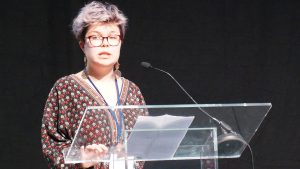 Our youngest diocesan representative on the Church in Wales’ Governing Body Melody Lewis (right) from Holywell has recently visited Berlin exploring the theology of Dietrich Bonhoeffer and reflects on her time in the German capital.
It was eighteen hours into what was supposed to be a breezy twelve hour train trip from London to Berlin when I began to question what reconciliation meant to me. Having set off from my home in Holywell almost twenty four hours beforehand, I was understandably cranky, tired, and most of all, hungry. The delightful diner-style restaurant car on the train was, unfortunately, out of everything, save from a rather questionable vegan chicken wrap that looked more like it belonged in a lab on a petri dish than inside a human stomach, and the train was at a standstill due to an accident on the line. Even the complementary bottle of sparkling water which sat unopened in front of me looked appealing in that moment.
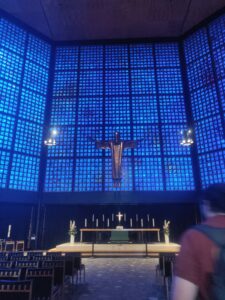
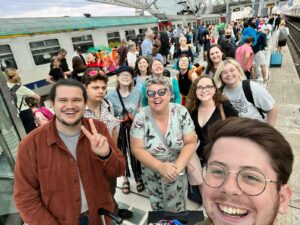 I was making my way to Berlin with a group of students as part of a Student Christian Movement trip funded by Project Bonhoeffer – a small UK-based organisation set up in 2011 to inform and remind today’s Christians – young and not-so-young – of the challenges of discipleship that Dietrich Bonhoeffer addressed in his radical theology and in his Christian witness, which ultimately led to his execution at the hand of the Nazis at the end of the Second World War. The focus of the trip was an exploration of the steps made towards reconciliation after the Second World War, and the subsequent erection and fall of the Berlin Wall. Through excursions to the Niemöller House, the Chapel of Reconciliation, and the Kaiser Wilhelm Memorial Church in the city centre, we were able to discover parts of the city’s history of separation and reconciliation – history that we students were all too young to have experienced.
 When thinking about reconciliation, it is almost impossible as a Christian to see the word in isolation from what we understand it to mean religiously. Biblically, reconciliation plays a huge role in the Christian canon. Often referred to as atonement, reconciliation in the Bible refers to the idea of healing the relationship between God and humanity, which was severed irreparably when Adam and Eve were thrown out of the Garden of Eden. This severing left a deep wound not only in humanity, but also in God, who was saddened by this corruption of her beautiful creation. It is often hard for Christians to understand why a loving God would cause such a thing to happen, but without such an event, the world would never have known the love of Jesus or his wonderful message. Yet in our largely secular modern world, it is often hard to come to an understanding of reconciliation that functions well within society today.
It seems that biblical reconciliation is often a romanticised ideal of what settlement and making amends actually looks like. Real-world reconciliation cannot be measured in abstract expressions of an otherworldly love, but rather in the smaller daily acts of acceptance that we make, often sacrificing some form of comfort in exchange for progress. Perhaps the most profound moment of the trip for me was our morning spent in the Chapel of Reconciliation. The Chapel, built in 1990 on the site of the original Church of Reconciliation which was destroyed in 1985 in order to increase security surrounding the wall, unites architectural and ecological modernity with remembrance, standing as a triumph against its predecessor’s destruction. Its memorial and reconciliation roles are recognised by the chapel being part of Berlin Wall Memorial and with it being included in Coventry Cathedral’s Community of the Cross of Nails: a world symbol for reconciliation and peace. Yet what I found most moving about this place of worship, was not the fascinating history, nor the efforts the parish has made to work towards reconciliation in the community, but the people behind the church itself.
 Covering the walls was an art installation of thirty individual stories from members of the congregation and people involved with the church. The tone of these stories was neutral; there was no celebration hidden behind the words, and neither was there hatred. One story in particular stood out to me as I explored the exhibition. It told the story of a man who had attended the original Church of Reconciliation as a child, and then returned to the parish after the new chapel had been built. He stated plainly how he thought the new chapel was ugly, that he didn’t like it, and it felt cold and uninviting as a building, but that he continued to attend as it was the church he had grown up in and didn’t know any different . No judgement was made alongside this statement, and no attempt was made to sanitise it either. For me, this felt like a stark display of what reconciliation really means for us as Christians today; we must not judge, and we must not hinder progress. Rather we must work together, following Jesus’ example, strive for a fairer, more loving, and inclusive world.