Teulu Asaph 21st May 2020
The Spanish Influenza (long version)
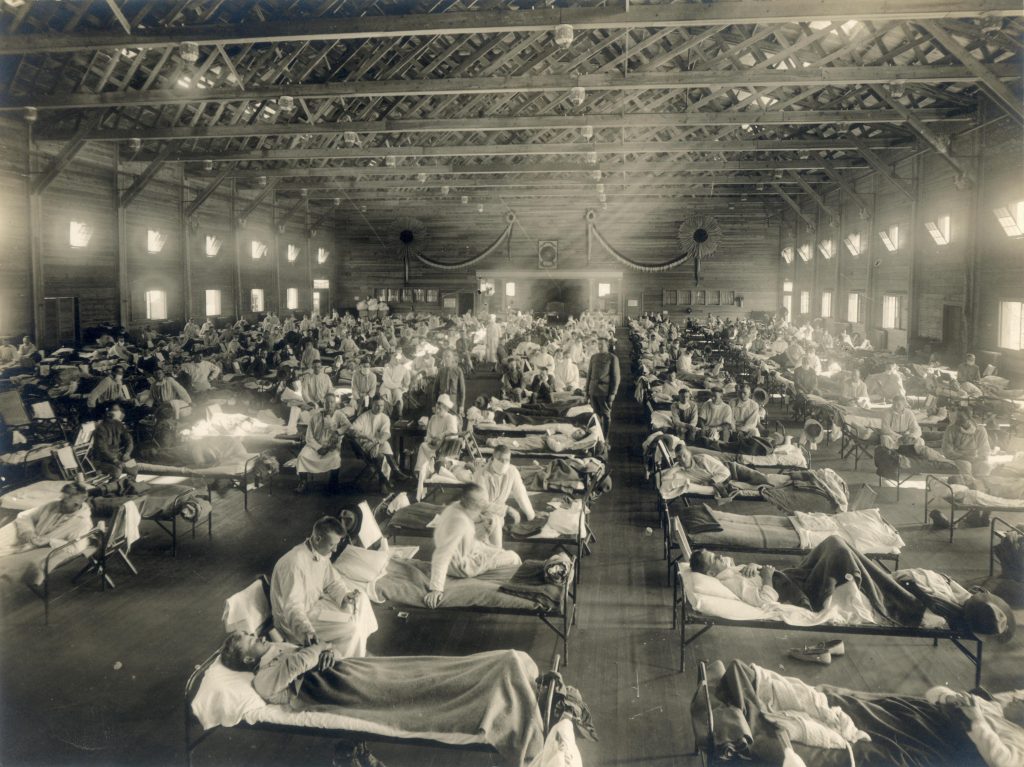
The Spanish Influenza
Long version in full
The Spanish ‘flu, which reached its peak in November 1918, killed more people globally than World War 1. There are strong parallels between what happened then and what is happening today with the Coronavirus pandemic. Then as now governments tried to balance the welfare of the nation against the welfare of individuals. Local historian Frances Ward uses newspaper accounts to describe how events unfolded in 1918.
What, when and how
The Spanish flu lasted from early 1918 until 1919, and killed between 50 and 100 million people worldwide. In Britain about 228,000 people died, around 11,000 of them in Wales. There were three waves of infection: the first, in the spring of 1918, was relatively mild, the second, right at the end of the war, in October and November 1918 was devastating, and the third wave, in early 1919, was somewhere between the two. Most deaths resulted from the fast onset of pneumonia.
It is not clear in which country the influenza started, but once it took hold, it spread extremely rapidly. During the worst outbreak it could develop so quickly into pneumonia that newspapers described people falling ill in the morning and dying in the afternoon, or simply ‘dropping in the street’. The Cambria Daily Leader, October 1918: ‘During the past seven days, 131 persons have been picked up [by ambulance] in London streets with sudden illness.’
The ‘flu thrived in the trenches, and badly infected men were moved from the front in crowded troop trains. Returning soldiers brought the infection to the cities, and from there it spread to the countryside. By late in the war, the civilian population, worn down by anxiety, stress, and malnutrition, was very vulnerable.
Keeping it quiet
As with other countries during the war, the British Government imposed press restrictions on reporting the ‘flu epidemic, to avoid lowering public morale. The worst outbreak coincided with the government’s desperate push to raise money to keep the army armed and afloat with the ‘Big Gun’ campaign, aimed at persuading people to buy war bonds. And although newspapers occasionally printed details of war casualties and influenza deaths in adjoining columns, the enormity of deaths at the front made the deaths from influenza appear less important.
In October 1918 the Liverpool Daily Post said: ‘The Influenza Epidemic: 386 deaths in Liverpool… but the public health authorities say there is no cause for panic… and everybody who has escaped so far is enjoined to keep themselves fit.’ And the adjacent column recorded ‘Toll of War: the casualty lists issued last night show the following losses: Officers – dead 69; wounded or missing 165. Rank & File – dead 1,003; wounded or missing 4,033.’
What was – or wasn’t – done
Then as now, different countries reacted to the pandemic in different ways. By summer 1918 the US had closed schools, churches and cinemas, banned large gatherings, insisted on masks being worn, and certificates of health being produced by train travellers. France closed down schools, theatres and churches, made spitting in the street a criminal offence, and employed extra people to clear rubbish. Australia operated a strict quarantine policy for anyone trying to enter the country.
From the beginning the severity of the illness in Britain was played down, and there was no centralised approach to preventing its spread. In July 1918 the London Globe wrote that ‘rapid, or three-day, influenza’ as it was called then, was an excuse for people who wanted a day or so’s holiday, with women the prime offenders, taking days off to coincide with the sales. The idea of wearing face masks was ridiculed, as ‘women would never wear such ugly things’.
Closures of schools, factories, mines, and transport systems were local short-term decisions based on whether there were enough well children to attend, or workers fit to carry on.
Occasional school closures were routine – in Montgomeryshire, for example, Meifod School’s log book during the war records short closures for outbreaks of measles and whooping cough, as well as lack of fuel to heat the school. However, on October 23rd 1918 the headmaster wrotes ‘Influenza broken out in the district, carried from a case in Much Wenlock.’ Two days later the local medical officer closed the school because so few children were attending. The school remained closed until 12th November.
Success in the war depended on keeping factories productive, particularly those making arms, and the mines working, so that the impact of the ‘flu was played down, with essentially the war effort taking priority over people’s health. Conditions in the mines lent themselves to transmission of illness, and in July 1918 the Birmingham Daily Gazette noted there had been twelve deaths in the Rhondda and 1000 colliers were ill.
Hardship and suffering
However, by October 1918, as the second, devastating wave of the illness began to take its toll everywhere, there were newspaper reports of influenza ‘raging in Italy’, ‘700 deaths in Sweden’, and ‘5,000 deaths in Capetown in a fortnight’. It began to be admitted that all parts of Britain were also severely affected. Even desperately needed recruitment for the army was put on hold because of the hundreds of deaths in army training camps.
By November 1918 there were calls for doctors and nurses to be brought back from the front to help communities cope. 52% of doctors were at the front, with those at home being older and less recently trained. In North Wales medical examinations for the army were suspended to release more doctors, while it was reported in the Western Mail that in Cardiff ‘ladies with nursing experience will be welcomed by the health department’. All medical help had to be paid for, and the Haverfordwest Telegraph flagged up that there were ‘districts in north Pembrokeshire where people were too poor to support a district nurse, and where inhabitants were suffering from the fearful scourge of influenza.’
Around 11,000 people died in Wales, and Caernarfonshire had the highest death rate in the whole of England and Wales (6.7 per 1000) with Flintshire nearly as bad. The statistics are chilling, and the Western Mail adds detail from applications to the Evening Express Flu Distress Fund: ‘At this address there were living last week fifteen persons. Of these, four died and five are still ill. The total income is 30s a week, and the funeral expenses have only partly been met. Nursing and necessities for sick are badly needed.’
Remedies and prevention
In 1918 there was no effective medical treatment for influenza or pneumonia. But by October there was sound advice on offer locally. Dr Tom Evans, the Medical Officer of Health in Swansea, was quoted by the Cambria Daily Leader, as being passionate about preventative measures. He sent information to all doctors in Swansea recommending that healthy people should keep away from infected people – unless nursing them – should get as much fresh air as possible, and keep away from public meetings, public entertainments and the inside of tramcars. He told the Leader that it was undesirable for any public gatherings to take place, and asked cinemas in Swansea at least to exclude children – but had no power to insist. The government didn’t share his concerns, however, making no attempt at the end of the war to limit the crowds at the Armistice celebrations, or to discourage local communities from planning events.
People resorted to traditional remedies, and at the first outbreak there was panic buying of quinine preparations. Gargles of diluted Condy’s fluid (a household disinfectant like Dettol) were recommended, while smoking cigarettes was believed to kill germs in the nose and throat, and carbolic soap and disinfectants containing formalin were used. Whisky was also recommended.
Advertisements for instant remedies abounded. ‘Veno’s Lightning Cough Cure’ was widely advertised throughout 1918, even when there were few news stories about the illness. The advertisements claimed success with coughs caused by gassing in the trenches, and then added that Veno’s also gave relief from Spanish flu. People were urged to ‘Fight the Flu with Formamint’ (tablets containing formalin) while ‘Dr MacKenzie’s Influenza Tonic’ if taken regularly would keep Spanish flu at bay.
How it ended
There was a third, less virulent surge, in Britain in February 1919. People continued to live in fear of it returning throughout 1919. ‘Summer colds’ that caused people to sneeze on buses brought back ‘such painful memories of the last big epidemic that people moved quickly away from the sneezer.’
In July the Peace Treaty was signed. The country’s mood changed: both the war and the ‘flu were over, and everyone strove to forget both as quickly as possible, despite deep personal memories of suffering for many. The fast and furious 1920s began, and ‘flu became ‘just’ another winter illness that could be expected to kill some people every year…