Royal Maundy
Its history and significance
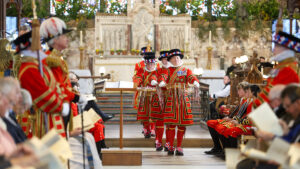 Maundy Thursday is the Christian holy day falling on the Thursday before Easter. It commemorates the Maundy and Last Supper of Jesus Christ with the Apostles, and the distribution of alms and the washing of the feet on the Thursday of Holy Week are an ancient tradition.
The Royal Maundy can be traced back in England to the 13th century, with the first recorded Royal Distribution at Knaresborough, North Yorkshire by King John in 1210. From the 15th century, the number of recipients has been related to the years of the Sovereign’s life.
During the service, The King presented the Royal Maundy gifts to approximately 77 men and 77 women. The Maundy Money is given in recognition of recipients’ outstanding Christian service and for making a difference to the lives of people in their local communities.
 His Majesty presented recipients with two purses containing the unique Maundy Money. In the white purse is a set of specially minted silver Maundy coins totalling 77 pennies, to match The King’s age, and in the Red Purse is a £5 coin commemorating 100 years since Queen Elizabeth II’s birth, and a 50p coin that celebrates the 50th anniversary of The King’s Trust.
The Royal Maundy Recipients are selected from with Anglican dioceses and alongside Ecumenical partners across the UK. This year, the Recipients have largely been chosen from the six diocese in Wales (Swansea & Brecon, St. Asaph, Bangor, St. Davids, Llandaff and Monmouth) alongside four English dioceses that are close, or border with, Wales (Chester, Hereford, Lichfield, Sodor & Man).
Each year the Monarch is assisted in distributing the Maundy Money by the Lord High Almoner, currently the Bishop of Norwich.
More information about Royal Maundy is available at www.royal.uk/royal-maundy-service.
In this film, Bishop Gregory, the Bishop of St Asaph, explains how people from the Diocese of St Asaph were selected to receive the Maundy Money.